I wrote a Facebook note translating a couple of French nursery rhymes into English to show how violent they were. If anyone has ever heard of the song "Alouette, gentil Alouette", let it be known that it is about plucking the feathers off a lark in order to cook and eat it. And the song is sung to the lark. The first line of each verse goes:
"Lark, lovely lark, I shall pluck off your feathers."
Seriously. And it's not the only rhyme like it. Une Souris Verte is just as bad, and you'd be surprised at the implicit sexual connotations in Au Clair de la Lune (only the last verse which nobody knows though). Anyway, all this got me interested in the origins of English nursery rhymes, and I decided to write a blog for each one I decide to analyse. Today's rhyme will be Ring a ring of roses.
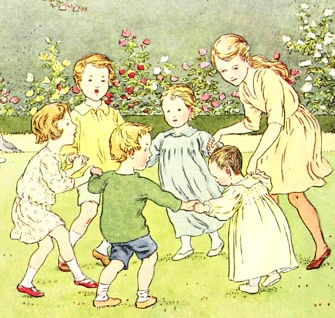
For information about the various versions of this rhyme, I recommend the easily accessible Wikipedia page I found on the subject. There are too many versions for me to go into here, but the version I used to sing as a child when thus:
Ring a ring o' roses
A pocket full of posies
Atishoo! Atishoo!
We all fall down
Fishes in the water
Fishes in the sea
We all jump up
With a 1-2-3!
I was once told that this rhyme dated back to the time of the black plague back in the 17th century, and for a long time I believed it. It seems logical: the first symptom of the disease was a rosy rash, people carried posies amongst other herbs to ward it off, sneezing was another symptom, and "we all fall down" is quite explicit. I decided fish was probably seen as some miracle cure for the plague, but this was mere supposition on my part.

I even managed to connect this interpretation to two other stanzas I found in a book of nursery rhymes my sister owned, that went like this:
The King has sent his daughter
To fetch a pail of water
Atishoo! Atishoo!
We all fall down
The robin on the steeple
is singing to the people
Atishoo! Atishoo!
We all fall down
The first stanza made reference to the disease spreading through water, which was true because they had no proper sewage system back then. The second made reference to the plague being transmitted by the fleas of animals which would then bite humans, contaminating them. As a child I was taught that rats were mostly responsible for this, although the people killed dogs and cats too.
However, apparently this interpretation isn't quite right. For a start, the rhyme was only linked to the bubonic plague after WW2, which is quite late. Secondly, there are versions of it from all over the world, including in Japan, and I think the bubonic plague was limited to Europe. Finally, I'm also pretty sure that the black plague was so named because the rash was black, not rosy.
The link between the plague and the nursery rhyme may therefore have been coincidental. Perhaps Ring a Ring o' Roses was just a bunch of simple words put together by children in the eighteenth century. It's possible that this particular rhyme is as innocent as the children who still sing it.
I prefer to think otherwise.


 Posts
Posts


No comments:
Post a Comment